
Why EXM Dynamic Credit fund ?

Our “Dynamic Credit Fund”, is a total oriented fund designed to generate consistent returns through a combination of income and capital appreciation investments .

The fund innovative risk management always seeks to deliver attractive returns and defensively preserve Capital through its external hedging and credit cycle, using more derivatives than traditional bond funds in order to limit volatility while generating  ROI ( Returns on Investment), and holds a relatively concentrated portfolio of traditional and non-traditional fixed income securities, money markets, legal cannabis, forex, and asset backed securities across global and US markets.

When you invest in our Dynamic Credit Fund,  you’re likely interested in preserving capital and the diversification benefits  relative to some of the assets in your overall portfolio.”

Diversification matters because stocks will return to more historically typical levels of volatility after a long period of calm and adding other credit instruments such as bonds to a portfolio provides a counterweight 

Capital preservation also matters because as baby boomers exit the workforce and Generation X eyes retirement on the far horizon , an increasing number of investors are more concerned with holding on to what they have than with seeking growth.

If the traditional benefits of diversification, income appreciation, and capital preservation appeal to you, then adding our Dynamic Credit Fund to your portfolio will be a good first step to consider.

Availability

  • There is no income limit for Participation
  • Must be an adult 18, and 21 in some countries
  • Account minimum of $30,000

Control

  • The Account owner retains sole ownership
  • The Account owner maintains control of withdrawing.
  • The beneficiary can be changed to another member of the same family without income tax consequences
  • The Fund offers flexible payment and withdrawal options.

Investment Objective and Strategy

  • The Fund seeks to provide capital growth , current income , and preservation of capital through a portfolio of asset class performance in the global financial markets ,and fixed income securities
  • Via the Fund , investors gain diversified exposure to this dynamic asset class performance by the way of the funds unique investment approach

Key Benefits

  • The Asset Management Team includes financial experts with over 45 years of combined experience in the fund, and asset management industry
  • The fund offers the most diverse and holistic route into the global markets
  • The fund has strict concentration, strategy allocation and liquidity rules limiting maximum exposure

CONTACT US

The Week in review-US Financial Markets

Read time : 6 mins

Economic and political backdrop

Stocks had a poor start to last week, as concerns over the worsening of the pandemic in several states as well as a new outbreak in Beijing seemed to continue weighing on sentiment. The market then rebounded late Monday following the Federal Reserve’s announcement that it will begin buying a broad portfolio of US corporate bonds. The purchases will be made by the Fed’s Secondary Market Corporate Credit Facility, an emergency lending programme that to date has purchased only ETFs.

On Tuesday and Wednesday, Fed Chair Jerome Powell testified before Congress, urging that recent monetary stimulus be paired with more fiscal support. While no clear plans have yet to emerge, reports of a USD 1 trillion infrastructure plan being prepared at the White House seemed to further support sentiment. Markets early in the week also seemed to get a lift from a major study showing a common steroid drug, dexamethasone, helped save lives in serious COVID-19 cases, marking the first treatment to have a demonstrable impact on reducing the fatality rate.

The week’s economic data offered mixed signals as to whether the economy will be able to manage a “V shaped” recovery. On Tuesday, the Commerce Department reported a 17.7% surge in retail sales in May, better than double consensus expectations and the biggest gain in history – albeit one measured against the 23.3% cumulative decline over the previous three months. Labour market data disappointed, however. Weekly jobless claims fell less than expected, and continuing claims remained elevated, at over 20.5 million. A gauge of current manufacturing activity in the mid-Atlantic region surprised dramatically on the upside, indicating considerable expansion instead of continued contraction, but overall industrial production in May rose less than expected.

Equity markets

The S&P 500 recorded a gain of 1.9% (-2.9% YTD), erasing part of the previous week’s steep declines. The technology-heavy Nasdaq Composite fared best and briefly moved close to the all-time intraday high it established on 10 June. Energy stocks led the rebound, helped by signs that major oil-exporting nations were adhering to previously agreed production cuts as well as optimism for increased global demand. The price of a barrel of Brent ended the week at USD 42.2, up from USD 38.7. Healthcare and materials stocks also outperformed, while airline stocks were especially strong early in the week, boosted by reports of a resurgence in air travel. The small real estate and utilities sectors lagged.

Value stocks underperformed growth stocks – the Russell 1000 Value returned 0.5% (-14.9% YTD) and the Russell 1000 Growth 3.1% (8.9% YTD) – while small capitalisation stocks outperformed, with the Russell 2000 returning 2.3% (-14.2% YTD).

The week ended on a volatile note due in part to Friday’s “quadruple witching” – the simultaneous expiration of four types of options or futures contracts, occurring once each quarter. The rebalancing of the S&P 500 and several other benchmarks was also likely to result in elevated volumes and price movements.

Fixed income markets

Reflecting the conflicting economic signals, US 10-year Treasury yield ended the week roughly unchanged at 0.70%.

Investment-grade corporate bond credit spreads moved tighter after the Fed announced that it will begin buying individual corporate bonds to supplement its purchases of ETFs. However, spreads moved wider as the week progressed amid increased selling to fund purchases in the primary market. The volume of new deals was well above expectations.

News of the Fed’s expanded bond-buying programme was supportive for the performance of high yield bonds. This was particularly true of issues from “fallen angels” – companies that have recently lost an investment-grade rating. While the robust retail sales numbers also fostered positive sentiment towards risk assets, the high yield market struggled somewhat to absorb a large volume of new deals.

Primed  to Endure 

Quick Thought (Saturday , June 20th, 2020)

EXM is now $200M + AUM and 550+ clients strong . Feel free to spread the word.

There seems to be growing conviction that many of the effects of COVID-19 will prove to be temporary.

That there will be full flights again. That corporate elevators will be densely packed. That restaurants will return to peak utilization. And ultimately, that the economy will return to its pre-pandemic state in no time.

Perhaps there is some truth to this. We sure hope so. But not everything will be the same – and some things for the better.

This is where the key to capitalizing on today’s market lies: disentangling the passing trends from the enduring structural changes that COVID-19 will have.

To frame it simply: which aspects of quarantine are here to stay?

Amazon, in this regard, is a “prime” company to examine  In Q1, Amazon’s sales rose by +26% after the e-commerce giant benefited from a surge in purchasing during the initial lockdown (e.g., consumers bulk ordering essential goods).

As shops begin to reopen, many investors are unsure to what extent this upswing will last. Was the stocking-up simply a “pull-forward” of demand, setting AMZN up for an eventual drop in the stock?

Sure, Amazon’s activity may peak in the short term. But longer term? We believe COVID-19 has structurally altered the retail landscape in Amazon’s favor.

For example, older generations — who traditionally preferred to shop at physical stores— have now set up online Amazon accounts, adopting the digital world years sooner than many predicted. Meanwhile, COVID-19 has catalyzed the bankruptcies of brick and mortar competitors. The accelerated shift to e-commerce is a structural change Amazon is primed to endure.

You can spot other enduring changes firsthand. What else do you think is here to stay? Will you continue to pay for Zoom? Do you think your company will let you work from home more frequently? How does that change how you’ll live your life? 

Behind these changes may be some lucrative investment opportunities. 

Have a great weekend,

EXM Research

What you own

For EXM  clients: (+) is a positive read-

through, (-) negative, (~) neutral

(+) Uber up +4% after partnering with Marin Transit to offer public transit in-app. First instance of Uber entering the software-as-a-service (SaaS) market.

(~) Facebook up +3%. Looking to take a more active role in politics on their platform after announcing the option to turn off political ads and removing Trump campaign ads for violating policy on the use of hate symbols.

Weekend reads

Permanent Assumptions (5 min read). 

Insightful article about how assumptions can act as guides towards personal and professional success.

We Are All Confident Idiots (20 min read). 

Comprehensive read on the fascinating human psychology of ignorance.

Roll over your retirement assets to EXM Titan

100 of EXM clients have rolled over their retirement accounts (IRAs, 401K’s, 403B’s, etc.) to us in recent months, aiming to grow their retirement savings at better rates of return.

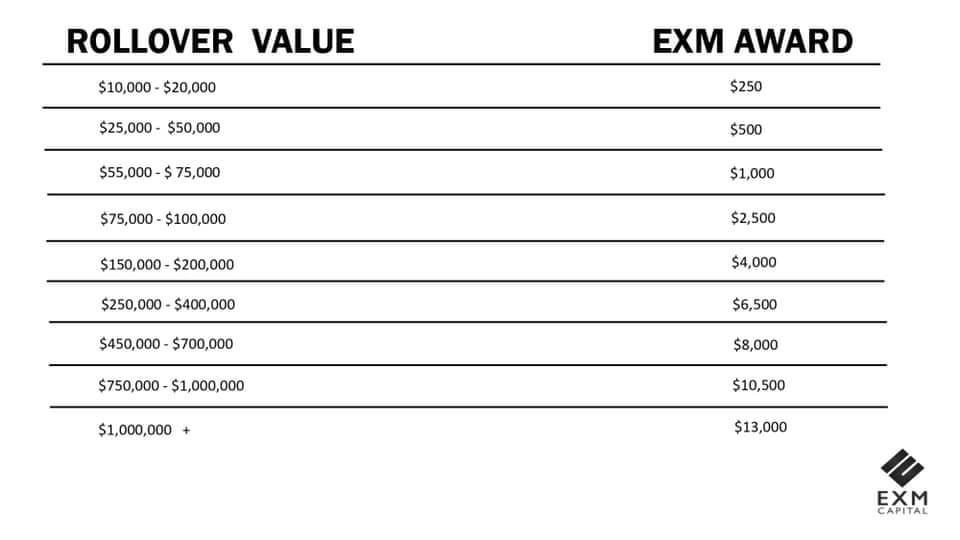
Plus, with our Rollover Award, you can earn up to $10,000 by rolling over.

Here are all the account types you can roll over to a EXM IRA:

•Traditional IRA

• Roth IRA

• SEP IRA

• SIMPLE IRA

• 401K

• 403B

• TSP (Thrift Savings Plan)

You can also do a partial rollover. Any existing referral credits on your Individual account will apply to your IRA(s), too. 

Rolling over is easy: just click below and attach a recent statement for the account you wish to roll over. Our IRA Concierge will take it from there.

Start your rollover

A detour

“The pessimist complains about the wind. The optimist expects it to change. The realist adjusts the sails.”

William Arthur Ward

$200 Million in AUM

EXM Capital Crosses $200 Million in AUM

EXM

We just crossed $200 million in assets under management (AUM), a huge milestone we couldn’t have achieved without you. And one we achieved in only 9 years time, making EXM Capital one of the fastest growing asset management firm.

Given the impact COVID-19 has had on the economy, we don’t take our business’s strength for granted. The full team has been working day and night (remotely) to make EXM Capital the best it can be. And we’re really still just in the 1st inning of our journey

The Wall Street Restaurant

EXM Capital’s launch in 2011 was largely born out of frustration. The way we had managed money for wealthy clients was much different than the passive ETF approach often recommended to our own friends and family.

To us, Wall Street was like a restaurant. Have only $10,000? Here’s the normal menu. Have $10 million? Let us show you to a private room in the back of the restaurant, with a 7-course meal. We were determined to bridge that divide

We launched our first investment strategy, EXM Flagship, in February 2011. In just 9 years, Flagship has grown faster than we ever predicted:

•   From $200k to $200+ million in AUM
•   From 5 to 550+ clients
•   From $0 to $38+million in net profits for clients 

EXM’s growth has accelerated during COVID-19 to record levels, a testament to the strength of our trading platform and business. As such, despite being backed by some of The best investors, we are no longer dependent on outside funding.

Unlike other companies pursuing growth at all costs, we’ve laid the foundation for a multi-generational firm. This enables us to take a long-term view with your capital and provide you things that others can’t, like investment strategies that previously had $100K minimums.

Only the 1st Inning

Our journey is truly just getting started. Here’s a sneak peek of EXM’s future:

•   New account types (like Joint, Custodial, Trust, and SEP IRAs)
•   More proprietary investment research
•   More third-party integrations
•   More performance metrics
•   Full-fledged web app

How You Can Help

If you’re loving EXM, there are a few ways to help advance our mission:

  1. The biggest endorsement is through your relationship with EXM Capital as your active money manager. If you have accounts elsewhere (taxable, IRA, 401K, 403B), you can roll them over to EXM Capital easily. Just message the support team at info@exmcapitals.com

2. Help us spread the word! You can tell your friends, family, and colleagues about EXM Capital, or write a positive review online. Reminder: we don’t spend money on marketing to grow. We rely solely on the reviews of our valued clients.

We’re honored to manage over $200million for 559+ clients from all walks of life, with a shared mission: to compound capital at higher rates through the most transparent, high-quality investing experience on the planet.

Onward!

Peter Buhler
Chairman EXM Capital

May 2020 Market Commentary

Marek Bielec, Portfolio Manager

June 15,2020

In my last commentary, I focused on several indications that the adoption of bitcoin and digital assets may be entering a new paradigm. Throughout May we continued to see an increased level of interest across every type of investor, from wealth channels to independent RIAs to institutions. The market remained range-bound, sustaining gains captured during April’s rally as bitcoin finished higher with a price of $9404.22 for an increase of 6.55%, while the Bloomberg Galaxy Crypto Index was up slightly to 374.02 for a gain of 0.16%.

May opened with a flurry of activity as one of the world’s most successful macro investors, Paul Tudor Jones, made headlines by announcing his bitcoin investment and laying out his case for why it will have an important role in portfolios given the changing macro environment. This was a watershed moment for bitcoin in many ways, further underscoring its graduation from the world of “cypherpunks” and early adopters to that of sophisticated and professional investors. The Tudor Jones announcement was followed by bitcoin’s third halving event, which highlighted its fixed supply in sharp contrast to unprecedented stimulus via the CARES Act. As the month progressed, markets rallied worldwide with local economies beginning to plan for reopening, sparking hope that a recovery was plausible in the near term.

As recovery news continues to bolster the markets and the greater economy, it is important to remember that macro risk still looms large. The Fed’s rampant money printing may have left the headlines, but the future impact of recent monetary decisions on the greenback is not going away. Economic aid of this magnitude implemented in this broad a manner will likely affect our economy for many years to come. Additionally, it has yet to be seen whether added stimulus may be needed should the reopening falter and/or a second wave of this deadly pandemic resurfaces in the near term. No matter what happens, bitcoin will remain a non-sovereign, limited supply, and deflationary hard asset with growth potential.

During much of the first half of 2020, adopters of digital assets have focused on bitcoin’s investment thesis from a macro perspective. In addition, we have spent an immense amount of time weighing bitcoin’s value as digital gold and its role in a digitized society. However, I’d be remiss if I did not address another of bitcoin’s long-standing narratives and how it may factor into the current state of our society.

Our Chairman Peter Buhler has strong conviction in bitcoin from a macro perspective, but also for its role as a new form of social construct. Remember, bitcoin was founded on the premise that we cannot necessarily trust our financial system following the 2008 Crisis. Following the senseless and tragic death of George Floyd, our society was thrust into social unrest. Cities worldwide have seen protests calling for an end to systemic racism, with citizens demanding sweeping changes to systems politically, socially, legally, and economically. While the bitcoin narrative pales in comparison to that of racial equality, bitcoin’s decentralized nature points to the role it may play in the future. Bitcoin is founded on the premise of fairness, and it is not owned by any organization, altered by any opinion, or controlled by any governing body.

It has been stated that bitcoin may be a call on the future of our financial system. It may have a role in our new social construct as well.

Subscribe to our monthly newsletter with this commentary and more via the form at the bottom of our home page.

Special Commentary from Asher Schur – June 2020

Asher Schur, Head of Asset Management

June 3,2020

It is an understatement to say the last few months have been eventful, with traditional and crypto markets being no exception. The EXM team hopes you and your families are safe, healthy, and sane.

We remain laser-focused on a number of exciting developments for bitcoin. Below are my thoughts on the most important developments, which include an increased recognition of bitcoin’s utility as an inflation hedge, a bitcoin adoption path that is becoming clear, and the reality that the world is digitizing at a breathtaking pace. All three strengthen our foundational conviction in the thesis for bitcoin’s inclusion in a diversified portfolio.

If you have any questions or would like to learn more about our EXM Digital Funds please feel free to contact info@exmcapitals.com

Best,

Chris

Increased Recognition of Bitcoin’s Utility as an Inflation Hedge

Last month’s news that legendary macro investor Paul Tudor Jones purchased bitcoin for his hedge fund, Tudor Investment Corp, may represent a watershed moment for the institutional adoption of bitcoin. In a letter to investors, Tudor Jones compared bitcoin’s role in a portfolio today to that of gold in the 1970s and bet that bitcoin would be the best-performing hedge against the current Great Monetary Inflation. He subsequently noted that he holds 1% to 2% of his assets in bitcoin as a hedge against a possible decline in the value of the US dollar.

We have previously written and spoken about the benefits of owning bitcoin as an inflation hedge, and we feel that the halving event (the coin’s annual inflation rate is lowered from 3.6% to 1.8%) elegantly juxtaposes bitcoin’s scarcity with the real-time evidence of fiscal profligacy (e.g., 2020 US deficit estimates of nearly 20% of GDP1).

Bitcoin’s Adoption Path is Becoming Clear

Over the course of 2020, we expect to see bitcoin adoption levels increase across two major investor categories, both of which have largely avoided crypto to date: traditional hedge funds and wealth channels.

Tudor’s dive into bitcoin comes on the back of another legendary fund manager, Renaissance Technologies, reportedly entering the world of bitcoin trading. Other hedge fund managers, like Bridgewater’s Ray Dalio, continue to warn of the inflation risks associated with a dramatic uptick in government spending, coupled with unprecedented levels of monetary easing. As the world wakes up to this growing portfolio risk, the question investors ask large hedge funds becomes: what are you going to do about it? The traditional inflation protection toolkit for macro and multi-strategy managers includes leaning into scarce commodities (like gold) and certain portions of the equity market, while avoiding long-duration fixed income. The Tudor news means the proverbial Rubicon has been crossed for bitcoin, which can now be considered another inflation fighting tool for hedge funds. We expect other hedge funds to follow in Tudor’s footsteps.

Traditional wealth managers, like hedge funds, are also waking up to the potential diversification and purchasing power preservation benefits of including bitcoin in client portfolios. Two weeks ago, we surveyed hundreds within the financial advisor community, and found that 54% are likely to make an allocation to bitcoin in client portfolios over the next 12 months, and 53% have developed a more positive view of bitcoin over the past six months—less than 3% indicated a more negative view. This perception shift follows significant improvements to the institutional infrastructure (e.g., blue chip custody solutions coming to market from Fidelity and ICE), the launch of higher quality fund products that serve as more comfortable on-ramps, and a higher awareness of—and need for—bitcoin’s value proposition as a scarce asset.

The World is Digitizing More Rapidly

We are not surprised that renewed interest in bitcoin has occurred alongside a broad acceleration of digitization; Microsoft’s CEO recently said that the company has experienced two years of digital transformation in two months, and Gary Cohn wrote in the FT that the Coronavirus is speeding up the disappearance of cash. In the context of Cohn’s piece, it makes sense that early drafts of the CARES Act contemplated distributing stimulus payments to US citizens rapidly and directly via digital wallets. We have also closely followed the revamped, yet still significant, plans to launch the Facebook-backed Libra project and bring digital wallets to Facebook’s 2.5 billion users. We believe in a future in which digital money (USD, Chinese RMB), digital payments (Libra), and digital stores of value (bitcoin) exist side-by-side. Each of these projects will require ongoing and sustained investment in digital payment rails and infrastructure, a reality which, in our view, offers material support to the bitcoin as a digital store of value thesis.

1 Per the Committee for a Responsible Federal Budget, the fiscal 2020 US budget deficit is expected to hit a record $3.8 trillion, 18.7% of US economic output.

The Week in review-US Financial Market

Economic and political backdrop

Optimism about the gradual reopening of the global economy seemed to be the primary driver of sentiment last week. As restrictions on public gatherings continued to be lifted and retail establishments and restaurants received permission to serve customers in limited numbers, the daily number of new confirmed coronavirus cases rose moderately in some states but perhaps not as much as feared. Investors also seemed encouraged by news of human trials of a possible vaccine for COVID-19 under development by a US biotech firm.The week’s economic reports also appeared to be less bleak than many had anticipated. April durable goods orders outside of the volatile transportation segment fell 7.4%, roughly half as much as expected. Another 2.1 million Americans filed for unemployment benefits over the previous week, which was slightly above expectations, but investors seemed reassured that the number continued to trend downward. Continuing claims for unemployment benefits also fell unexpectedly by roughly 4 million. Housing data were mixed. Sales of new homes rose at a robust pace in April, but pending home sales fell by nearly 22%, more than anticipated.China’s passage of legislation restricting the autonomy of Hong Kong resulted in sharp criticism from US officials and appeared to drain some of the positive sentiment, particularly late in the week. Shares of social media corporations also came under pressure after President Trump threatened to tighten regulations on social media platforms following a posting of a fact-check notice regarding one of his tweets. On Thursday, the president signed an executive order accusing the platforms of engaging in “selective censorship” and calling on the Federal Communications Commission to investigate whether they were operating in “good faith.”

Equity markets

The S&P 500 was up 3.0% (-4.7% YTD), recording a second consecutive week of solid positive returns (markets were closed on Monday in observance of Memorial Day). Slower-growing value stocks again gained ground against more highly valued growth shares – the Russell 1000 Value returned 4.4% (-15.4% YTD) and the Russell 1000 Growth 2.2% (5.5% YTD) – while small-capitalisation stocks were on par with large-capitalisation stocks – the Russell 2000 returned 2.9% (-15.7% YTD).At its peak on Thursday, the S&P 500 moved within 10% of its all-time high, pulling it out of correction territory, according to some definitions. Meanwhile, the technology-heavy Nasdaq Composite climbed within almost 3% of its February peak before falling back. Utilities stocks outperformed, while energy stocks moved lower on reports of an increase in domestic crude inventories. The price of a barrel of Brent ended the week little changed at USD 35.3.However, year to date energy, financials and other value-oriented stocks remained far behind their growth counterparts in the wake of the pandemic. Vaccine hopes fostered strong gains in the shares of cruise lines and other travel-related stocks in the consumer discretionary sector. Communication services shares recorded a solid rise as did energy stocks with the price of a barrel of Brent ending the week at US$35.1, up from US$32.5 a week earlier. Healthcare stocks lagged.

Fixed income markets
US longer-term bond yields ended the week slightly lower as US-China tensions counterbalanced optimism about economies reopening. US 10-year Treasury yield ended the week at 0.65%.The investment-grade corporate bond market saw steady primary market activity throughout the week, and the volume of deals exceeded expectations. New issues were generally met with solid demand, and credit spreads narrowed across most market segments.Another week of strong inflows to high yield funds contributed to positive sentiment and helped the market absorb a heavy slate of new deals. Fallen angels – issuers that have recently lost investment-grade status – continued to perform well amid strong interest. In credit-specific news, one of the largest global car rental companies filed for Chapter 11 bankruptcy protection late the previous Friday due to travel restrictions causing a collapse in demand for its vehicles. The Chapter 11 filing allows it to continue operations as it works to pay creditors and turn its business around.

Hidden judo strategies

COVID-19 has brought many businesses to their knees. Ambitious growth strategies have been replaced with survival tactics.

Many headlines seem to suggest that these decisions are purely reactive, “defensive” moves, like the shift to WFH (work-from-home).

For example, here’s what one retail consultant said: “There’s no other option [besides moving online]… Otherwise, you let someone else have your business. That’s why even Costco … TJ Maxx … are going online.” 

But one of the most under-appreciated strategies in business is one from the martial arts: the “judo strategy.” Or taking your competitor’s strength and turning it to your advantage.

Say there’s a stodgy incumbent that relies on cultural perks like unlimited snacks to attract top talent. A savvy startup that can quickly reposition itself to have perks for a remote-first world (think: Zoom poker tournaments) can exert a seamless judo move. “Enjoy perks? We have the best digital perks in town.” The incumbent’s previous strength now shifted to the startup. Coinbase is a great example of this.

We’ve seen examples of strategic judo across our Flagship portfolio recently.

For example, brick-and-mortar stores historically had a strong advantage: discovery. Browsing in-store had an element of intimate exploration that the internet found tough to match. But Facebook, sensing an opportunity during quarantine, just launched Shops which enables its users to connect their Instagram discovery to purchasing. Judo move.

Many strategies these days are in fact reactive, don’t get us wrong. But some go beyond just that – they react by taking their opponents’ momentum and siphoning it for themselves.

Judos can be very lucrative investments if identified before the herd catches on.

Have a great weekend,
EXM  Research

What you own

(+) Facebook +10%: Announced launch of Shops, a way for businesses to set up free storefronts on FB and Instagram. Will include an Instagram shopping tab, shoppable live streams, etc. Zuckerberg intimately involved.

(+) Apple +3%: Starting to buy older shows for its TV+ platform, stepping up its challenge to Netflix. Likely realizing that the formula for streaming success is a mix of both old and new content (like Seinfeld + Stranger Things on NFLX).

(~) Uber +6%: Cutting 3,000 more jobs, closing 45 offices, and reevaluating bets in freight and self-driving tech. Brutal but necessary cuts, they say.

(~) Netflix -4%: Now proactively helping subscribers who aren’t watching cancel their accounts. Talk about operating from a position of strength.

(-) Disney +8%: Lost its head of streaming video, Kevin Mayer, to the viral short video app TikTok where he’ll now be CEO.

Weekend reads

The End of Podcasting’s Innocence (8 min read)

Bullish take on Spotify: “Everyone knows that music is a tough business to be in. But it becomes decidedly less tough if you have leverage in the form of say, millions of customers who use your service to do something other than listening to music… The reality is that Spotify has the scale, not to mention the capital.

Amazon Wants to Innovate Its Way Out of the Pandemic.(3 min read)

Building its own testing lab, backing an immunology study, and more. “It’s part of the culture to build it yourself.”

“There’s No Other Option”(5 min read)

Costco, Gap and other retailers are sweetening their online offerings, but it’s coming at a cost.

A detour

“To secure ourselves against defeat lies in our own hands, but the opportunity of defeating an enemy is provided by the enemy himself.”

– Sun Tzu

ESG integration at EXM

EXM Capital believes a sustainable global economy is essential to the creation of long-term value. We integrate analysis of relevant environmental, social, and governance (ESG) factors into our research and investment decision-making processes within our equity and corporate credit teams. Our goal is to leverage ESG insights to both mitigate risk and augment returns, that is, outperform market averages, although there can be no guarantee of results. Incorporating material ESG issues into the investment process is a way of being smarter about investing. Attention to ESG issues is an emerging and important part of EXM’s culture – both within our research and portfolio management, as well as within our own corporate policies and values.

ESG integration in our investment group

“Investing through the lens of environmental, social, and governance (ESG) factors is redefining what asset management can accomplish”

— PETER BUHLER, CHAIRMAN, EXM Capital

Design a site like this with WordPress.com
Get started